How this product aligns with the EYLF
Developing early STEM and problem-solving skills
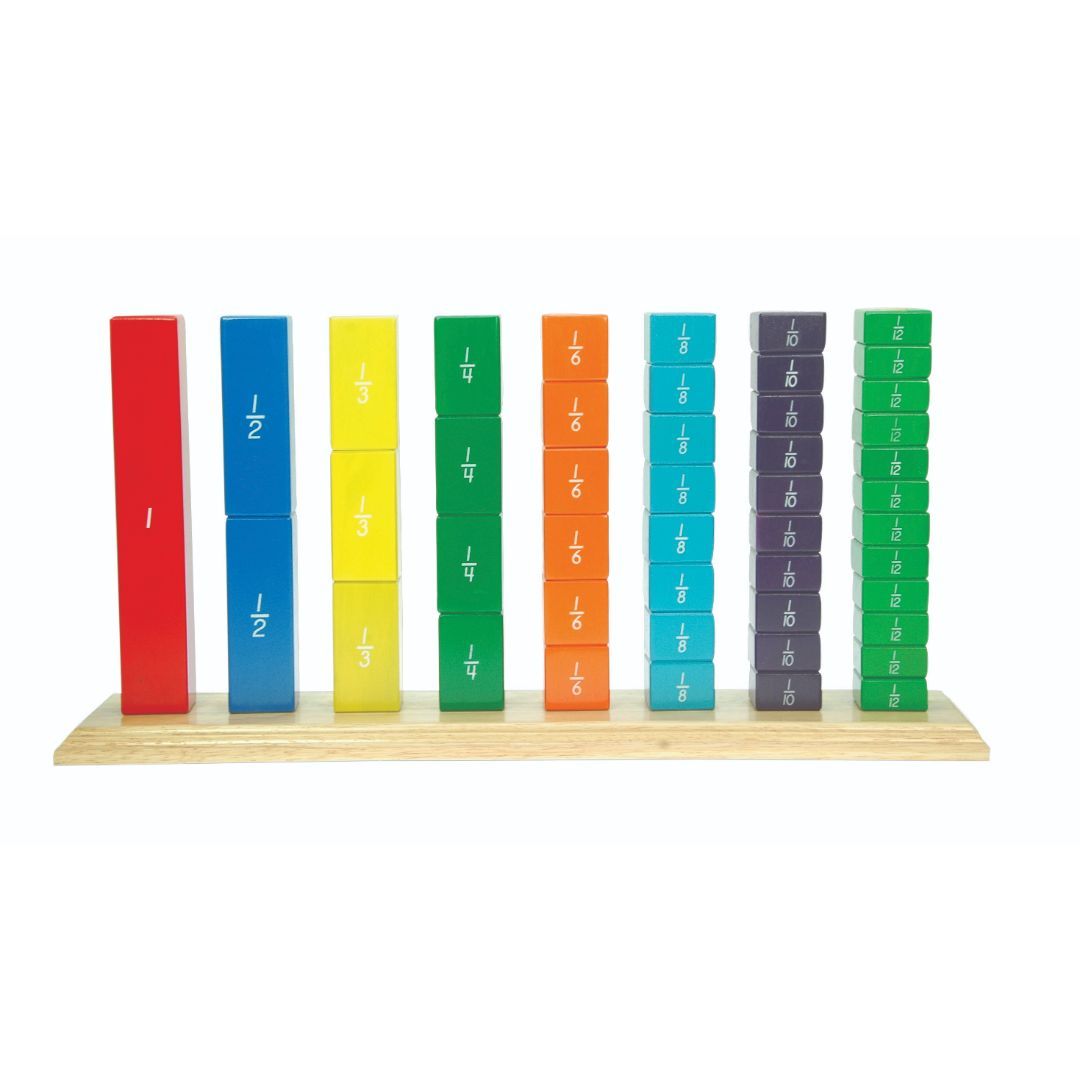
Rainbow Fraction Towers provide children with a tangible way to explore mathematical concepts such as fractions, decimals, and percentages. Through hands-on manipulation of the towers, children can engage in problem-solving as they compare, combine, and separate different pieces to understand relationships between whole parts and their fractions.
Supporting play-based learning and inquiry
This product encourages children to engage in play-based learning by inviting them to experiment with the towers in various ways. As children explore the different configurations and combinations, they are prompted to ask questions, make discoveries, and develop their understanding of mathematical concepts through inquiry-led play.
Relevant EYLF Outcomes
Outcome 4: Children are confident and involved learners.
Outcome 5: Children are effective communicators.
Classroom, Play Activity & Provocation Ideas
Classroom & Learning Area Ideas
Set up a dedicated maths corner where children can explore the Rainbow Fraction Towers alongside other mathematical resources, encouraging independent exploration and discovery.
Incorporate the towers into a visual display that illustrates the relationship between fractions and everyday objects, prompting discussions and inquiries.
Play-Based Activity Ideas
Encourage children to create their own fraction stories using the towers, fostering language development and narrative skills as they describe their creations.
Organise a collaborative game where children work in pairs to build specific fraction combinations, enhancing their problem-solving and social skills through teamwork.
Provocation Ideas
Present the Rainbow Fraction Towers alongside a variety of everyday items (like fruit or blocks) and ask children to represent these items using the towers, prompting them to think critically about fractions in real-life contexts.
Challenge children to create a fraction tower that represents their age or the number of siblings they have, encouraging personal connections to mathematical concepts.