
How this product aligns with the EYLF
Supporting play-based learning and inquiry
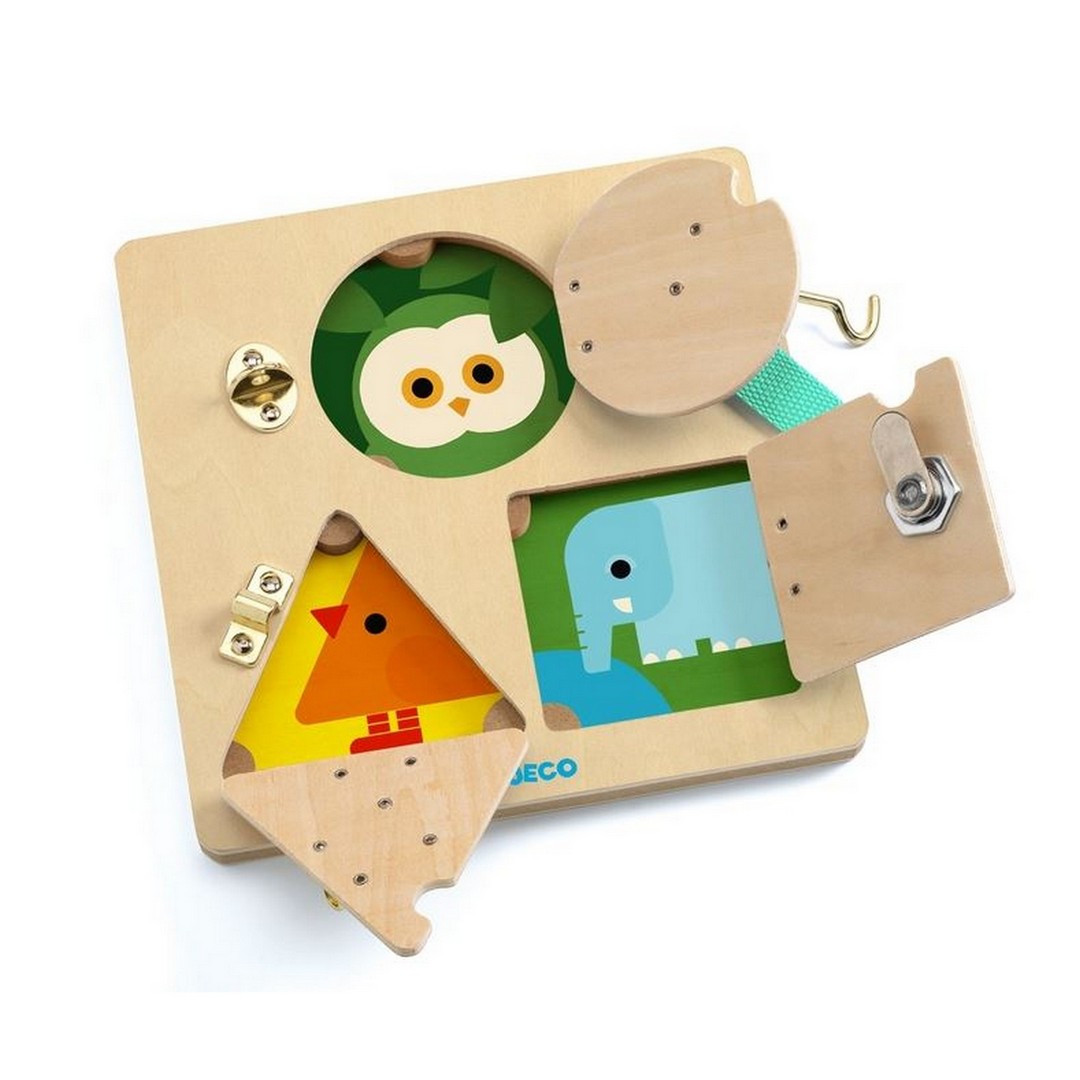
The Wooden Basic Lock Puzzle invites children to engage in hands-on exploration as they manipulate various locks and latches. This interactive experience encourages inquiry-based learning, where children can experiment with different ways to open and close the doors, fostering their natural curiosity and desire to discover.
Developing early STEM and problem-solving skills
Through the process of unlocking and locking the doors, children practice essential problem-solving skills and develop their understanding of cause and effect. The varied mechanisms challenge their fine motor skills and hand-eye coordination, laying a foundation for early STEM concepts as they learn to navigate the puzzle’s features.
Relevant EYLF Outcomes
Outcome 3: Children have a strong sense of wellbeing
Outcome 4: Children are confident and involved learners
Outcome 5: Children are effective communicators
Classroom, Play Activity & Provocation Ideas
Classroom & Learning Area Ideas
Set up a dedicated puzzle corner where children can explore the Wooden Basic Lock Puzzle alongside other manipulative resources, promoting fine motor development and independent play.
Incorporate the puzzle into a themed area, such as a ‘house’ or ‘animal’ corner, to enhance imaginative play and storytelling opportunities.
Play-Based Activity Ideas
Encourage children to work in pairs to unlock the doors, fostering collaboration and communication as they share their strategies.
Create a storytelling session where children describe the animals hidden behind each door, enhancing language skills and imaginative thinking.
Challenge children to create their own lock puzzle using cardboard and craft materials, promoting creativity and problem-solving.
Provocation Ideas
Introduce a discussion about different types of locks and latches in the real world, linking the puzzle to everyday experiences and enhancing their understanding of functionality.
Provide a variety of animal figurines that correspond to the illustrations behind the doors, prompting children to engage in role-play and narrative development as they unlock and discover.