How this product aligns with the EYLF
Supporting play-based learning and inquiry
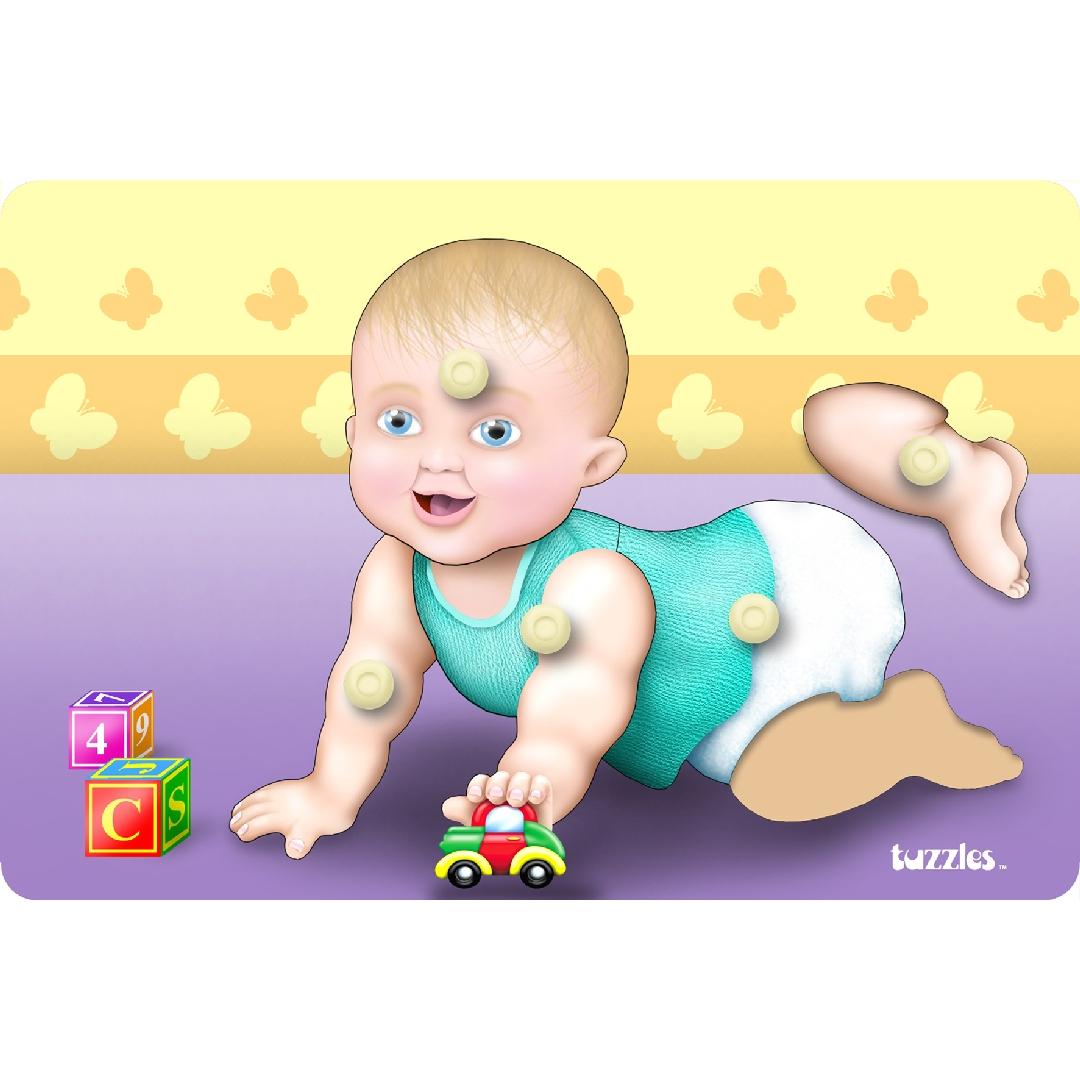
The Crawling Baby Peg Puzzle encourages children to engage in play-based learning by inviting them to explore the concept of body awareness through the imagery of a crawling baby. As children manipulate the pegged pieces, they are prompted to inquire about the different parts of the body, fostering curiosity and exploration in a playful context.
Developing early STEM and problem-solving skills
This puzzle supports the development of early STEM skills as children learn to fit the pieces together, enhancing their problem-solving abilities. The act of matching each piece to complete the image encourages logical thinking and spatial awareness, essential components of early mathematical understanding.
Relevant EYLF Outcomes
Outcome 1: Children have a strong sense of identity
Outcome 4: Children are confident and involved learners
Outcome 5: Children are effective communicators
Classroom, Play Activity & Provocation Ideas
Classroom & Learning Area Ideas
Set up a dedicated puzzle corner where children can freely explore the Crawling Baby Peg Puzzle alongside other puzzles, promoting independent learning and choice.
Incorporate the puzzle into a themed area focused on body awareness, using it as a visual aid to discuss body parts and movements.
Play-Based Activity Ideas
Encourage children to work in pairs to complete the puzzle, fostering collaboration and communication as they discuss where each piece fits.
Create a storytelling session where children can use the completed puzzle image as a prompt to share their own stories about crawling and movement.
Introduce a game where children take turns hiding one piece of the puzzle and giving clues to their peers about its location, enhancing their problem-solving and language skills.
Provocation Ideas
Present the puzzle alongside books about babies and crawling to stimulate discussion and further exploration of the topic.
Invite children to create their own simple puzzles using images of themselves or their peers, encouraging creativity and personal connection to the learning experience.