
How this product aligns with the EYLF
Promoting connection with the natural world
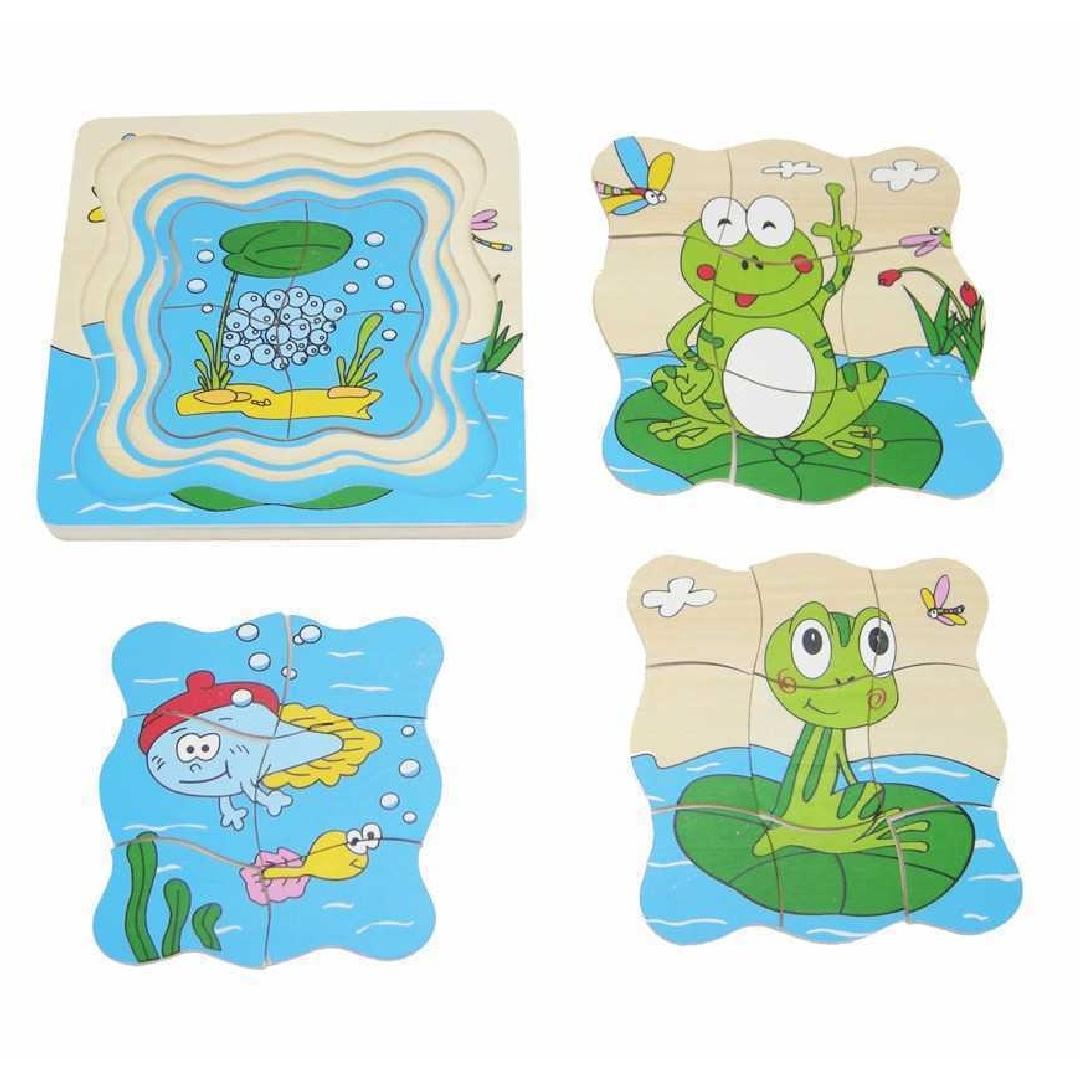
The Frog Life Cycle Layered Puzzle provides children with a tangible way to explore the life cycle of a frog, fostering a connection to the natural world. By engaging with the puzzle, children can observe and discuss the various stages of a frog’s development, encouraging curiosity about living things and their environments.
Developing early STEM and problem-solving skills
This puzzle supports children’s understanding of sequencing and biological concepts, which are foundational elements of early STEM learning. As children manipulate the layered pieces to complete the life cycle, they enhance their problem-solving skills and develop critical thinking as they figure out how the stages relate to one another.
Relevant EYLF Outcomes
Outcome 2: Children are connected with and contribute to their world.
Outcome 4: Children are confident and involved learners.
Outcome 5: Children are effective communicators.
Classroom, Play Activity & Provocation Ideas
Classroom & Learning Area Ideas
Set up a nature corner with the Frog Life Cycle Layered Puzzle alongside books and images of frogs to encourage exploration and discussion about amphibians.
Incorporate the puzzle into a science learning area where children can compare the life cycles of different animals using visual aids and the layered puzzle.
Play-Based Activity Ideas
Encourage children to retell the frog’s life cycle story using the puzzle pieces as prompts, fostering language development and storytelling skills.
Organise a group activity where children work together to assemble the puzzle, promoting teamwork and communication as they discuss the stages of the life cycle.
Create a sensory bin with water and toy frogs, allowing children to explore the concept of life cycles through imaginative play while referencing the puzzle.
Provocation Ideas
Introduce the puzzle during a discussion about habitats, prompting children to think about where frogs live and what they need to survive.
Use the puzzle as a starting point for an art project where children create their own frog life cycle illustrations, integrating creative expression with scientific learning.