
How this product aligns with the EYLF
Supporting play-based learning and inquiry
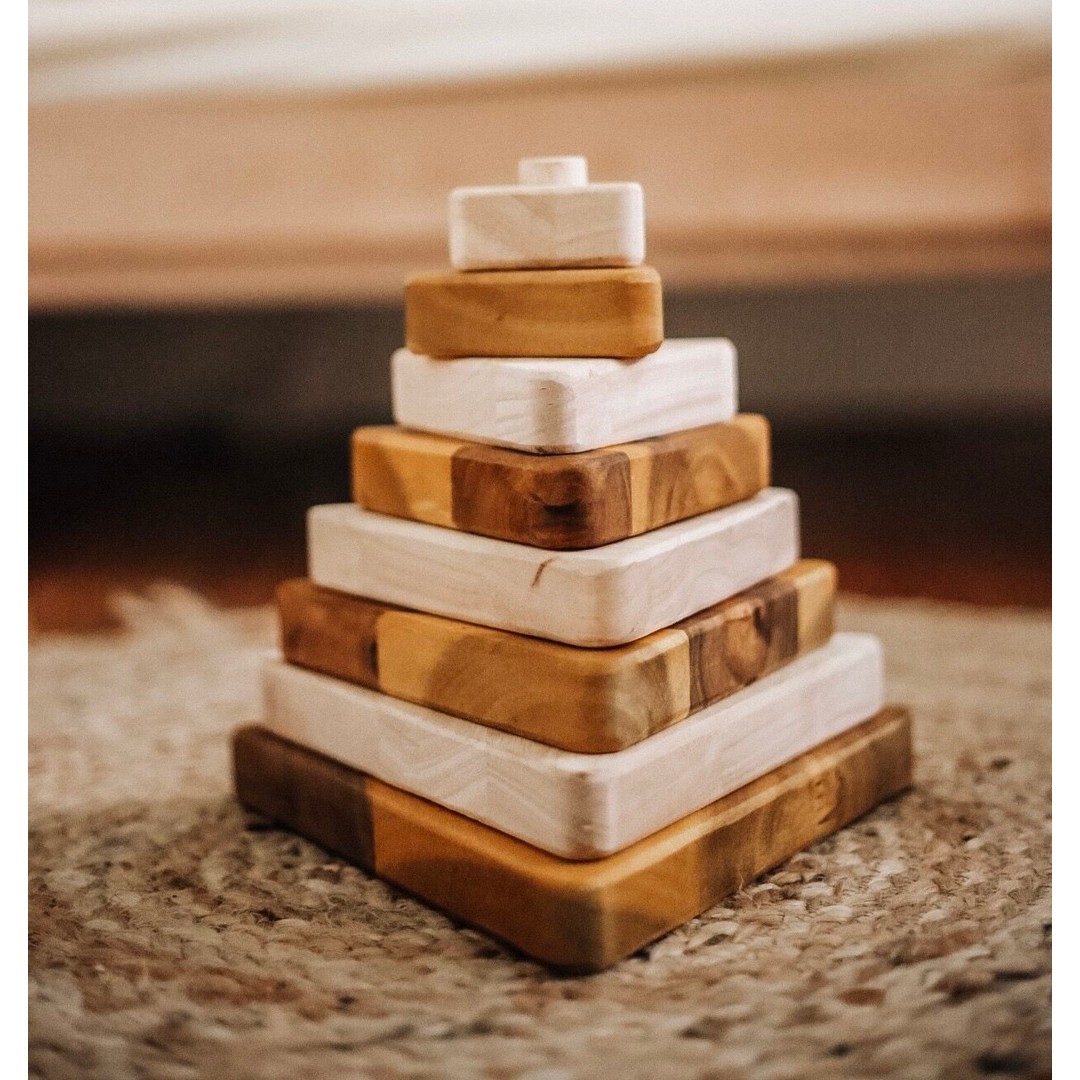
The Timber Stacking Triangle serves as an open-ended resource that encourages children to engage in play-based learning. Through stacking, sorting, and counting, children can explore concepts of balance and gravity while developing their fine motor skills. This hands-on experience fosters curiosity and inquiry as children experiment with different arrangements and configurations.
Developing early STEM and problem-solving skills
This product provides opportunities for children to engage with early mathematical concepts such as shape, size, and weight. As they manipulate the pieces, children can compare and contrast different attributes, enhancing their problem-solving skills. The tactile nature of the Timber Stacking Triangle invites children to explore mathematical ideas in a playful context, supporting their understanding of foundational STEM concepts.
Relevant EYLF Outcomes
Outcome 4: Children are confident and involved learners.
Outcome 5: Children are effective communicators.
Outcome 3: Children have a strong sense of wellbeing.
Classroom, Play Activity & Provocation Ideas
Classroom & Learning Area Ideas
Set up a dedicated maths corner where children can freely access the Timber Stacking Triangle to explore concepts of measurement and comparison.
Incorporate the stacking triangle into a sensory play area, allowing children to engage with the natural textures of the wood while developing their fine motor skills.
Play-Based Activity Ideas
Encourage children to create patterns with the stacking pieces, fostering their understanding of sequencing and symmetry.
Organise a collaborative building challenge where children work together to create the tallest or most stable structure, promoting teamwork and problem-solving.
Use the Timber Stacking Triangle during storytelling sessions, integrating the pieces as props to enhance narrative development and imaginative play.
Provocation Ideas
Present the stacking triangle alongside a variety of other materials (e.g., blocks, fabric) to inspire children to explore different ways of building and creating.
Invite children to investigate the weight of each piece by comparing them with everyday objects, prompting discussions about heaviness and lightness.