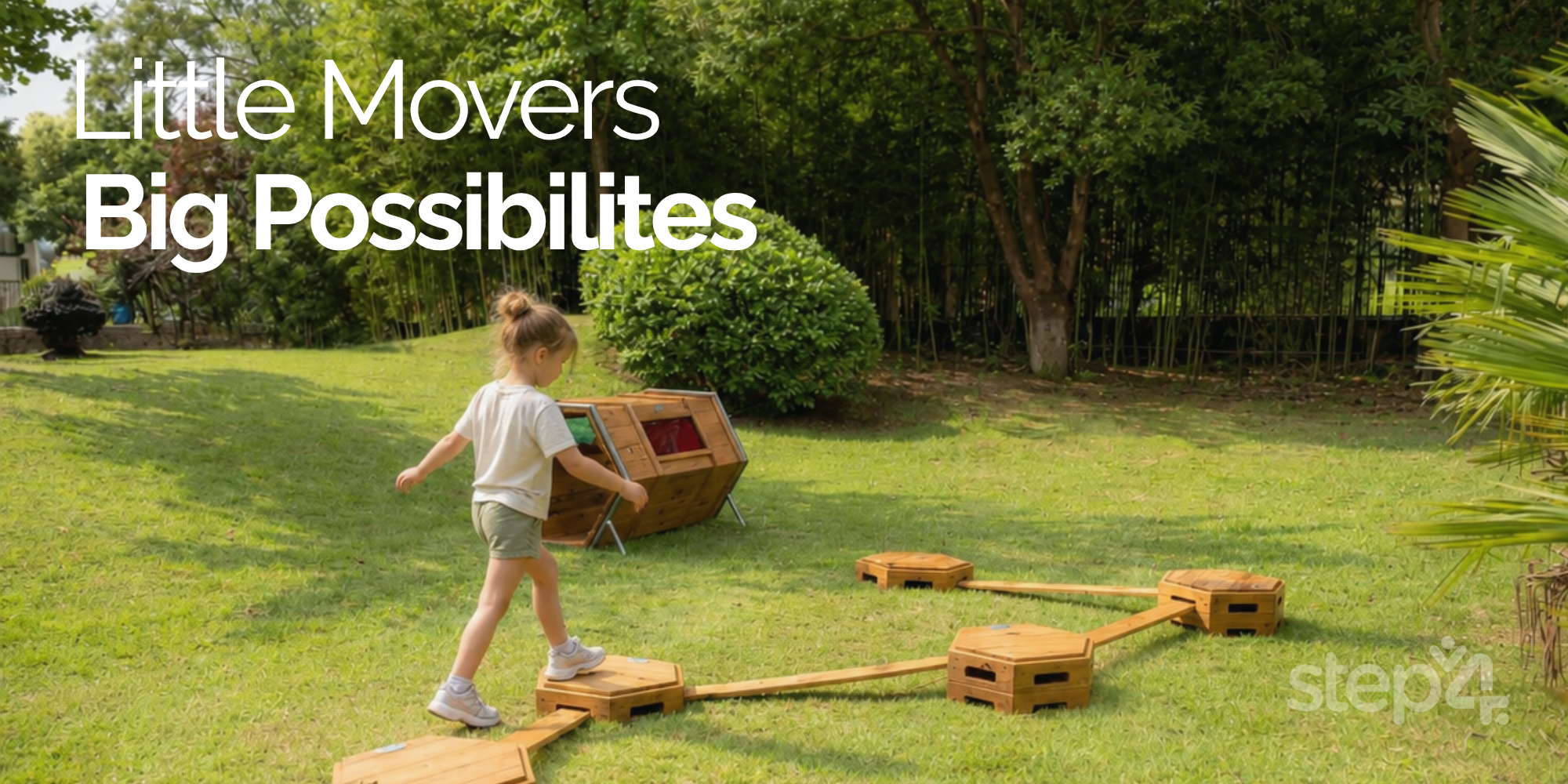
Watch any group of toddlers and preschoolers outdoors and you’ll see it. They scale the low platform, wobble along the log, and then do it all again. It looks like simple fun, and it is. It’s also some of the most important learning happening in your service.
Gross-motor skills are the big movements that use the large muscles of the arms, legs and core: climbing, crawling, balancing, jumping and carrying. They underpin much of what comes later, from sitting upright at a table to holding a pencil with control. Climbing and balance are two of the best ways to build them.
What climbing and balance build
Strength and coordination. Climbing asks children to use their whole body at once. They pull, push, grip and step, all while working out where their hands and feet need to go next. Over time this builds the core, shoulder and leg strength children need for everyday movement.
Balance and body awareness. Walking a beam or stepping across stumps teaches children where their body is in space (proprioception) and how to adjust when they wobble. Those micro-corrections are a workout for the brain as well as the body.
Problem-solving and planning. Every climb is a puzzle. Which foothold? Which way up? What if I go sideways? Children test ideas, adapt and try again, the same thinking that supports early maths and science.
Confidence and resilience. Few things build “I can do it!” like conquering something that felt just out of reach. Manageable, child-led challenge teaches persistence, and teaches children to judge their own limits, which is the foundation of healthy risk-taking.
Social connection. Climbing structures become mountains, ships and bridges. Children take turns, cheer each other on and negotiate who goes next, which builds communication and cooperation.
Linking it to the EYLF
Climbing and balance play can be documented against several EYLF V2.0 Learning Outcomes:
- Outcome 3, Children have a strong sense of wellbeing: children build physical confidence and learn to care for their own bodies.
- Outcome 4, Children are confident and involved learners: children show persistence, resilience and curiosity as they take on challenges.
- Outcome 5, Children are effective communicators: children negotiate, collaborate and share ideas during active play.
It also supports the National Quality Standard’s focus on learning environments that promote children’s health, physical activity and exploration.
Want to set up your learning environment for success?
You don’t need a large budget or an enormous yard. A few principles go a long way:
- Offer a range of challenge. Provide low, medium and higher options so children can self-select what suits them today.
- Mix fixed and flexible. Pair permanent structures with movable pieces like blocks, planks and stepping stones so children can rebuild the challenge themselves.
- Bring it indoors. Soft climbing blocks and balance equipment mean gross-motor play doesn’t stop when it rains, and it suits babies and toddlers who are just finding their feet.
- Supervise actively, intervene lightly. Be close, be present and resist the urge to lift children into positions they haven’t reached themselves. If they can’t get up on their own, they’re not ready, and that’s okay.
- Observe and extend. Note what children attempt, where they hesitate and what they achieve, then use those observations to plan the next challenge.
Our TOP PICKS for climbing and balance
- Nature Soft Gross Motor Block Set 15pcs, Outback Oasis: large, vinyl-covered foam blocks children can climb up and over, good for building strength and teamwork indoors or out.
- Classic Outdoors Balance Climbing Set: 10 hexagonal balance blocks and 4 connecting planks for flexible pathway creation.
- Netting Bridge: a dynamic netted bridge designed to support climbing, balancing and active play.
- Birchwood Infant Gym Set w/ Tunnel: Ideal activity space for young children keen to explore their environment and naturally build spatial awareness, confidence and gross motor skills.
Explore the full range in our Balance and Gross Motor Skills collection, or book a free consultation with our early learning experts on 1300 720 353 to plan an environment that gets children moving.